
Note:
You can request the SQL Profiling plug-in in the download area of the SoftProject website (SoftProject | Software X4 BPMS) on the X4 Add-ons tab.
The SQL Profiling plugin is used to store profiling data into a relational SQL database. To do so, you need to connect the SQL Profiling plugin to a relational SQL database. The plugin must be activated in the module.xml file in the <server_directory>\wildfly\modules\de\softproject\plugins\main folder.
The first start of the profiling must be executed by a database user who has the permission to create database tables. After all tables required have been created, a user with fewer permissions can take over.
Note:
When you enable the SQL Profiling, the default profiling in the memory is turned off.
How to install the plugin
-
Unzip the plugin ZIP file.
-
Copy the
sql-profilingfolder to the<server_directory>\wildfly\modules\folder. -
Open the
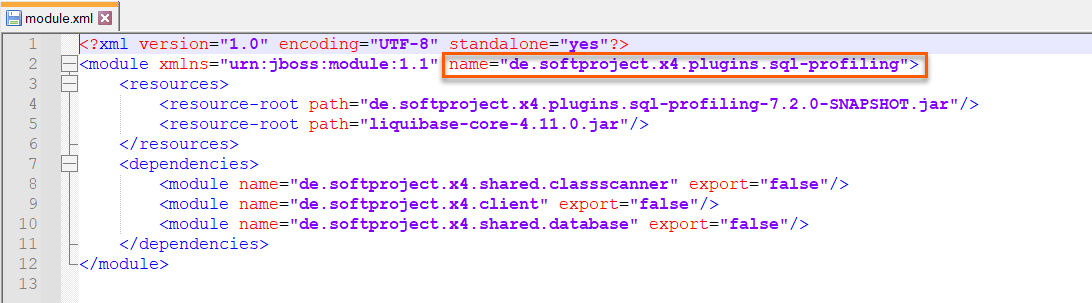
module.xmlfile in the<server_directory>\wildfly\modules\de\softproject\x4\plugins\sql-profiling\mainfolder. -
Copy the plugin name specified in line 2:
-
Open the
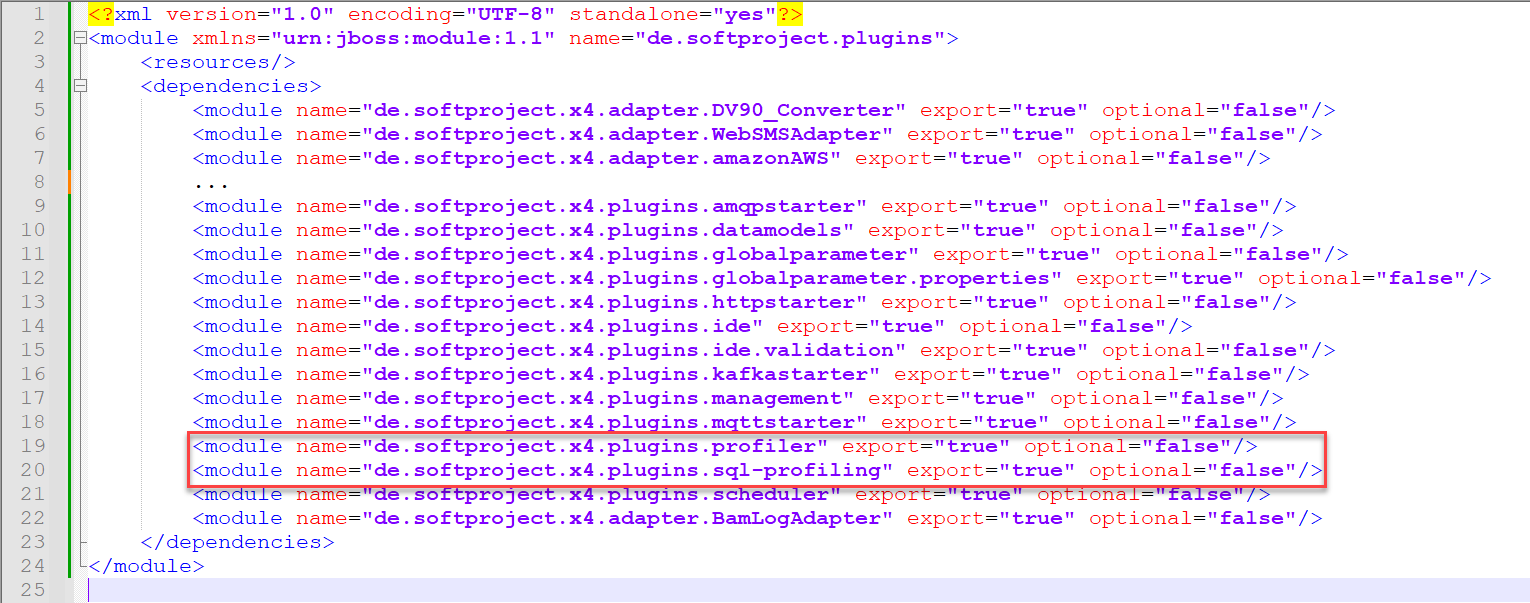
module.xmlfile in the<server_directory>\wildfly\modules\de\softproject\plugins\mainfolder. -
Add the following line to the
module.xmlfile:The file content should look like this:
-
Restart the X4 Server.
After restarting the X4 Server, the plugin will be available.
How to configure SQL Profiling
-
In the
<server_directory>/configurationsfolder, create thesql_profiling_config.xmlfile. -
Insert the following content.
XML<?xml version="1.0"?> <Configuration> <DatabaseConfiguration> <ConnectionString>JDBC-CONNECTION</ConnectionString> <!--OPTIONAL--> <JndiDatasource>java:/X4TEST_DS</JndiDatasource> <UserName>USERNAME</UserName> <Password>PASSWORD</Password> <MaxPoolSize>36</MaxPoolSize> <MinPoolSize>8</MinPoolSize> <InitialPoolSize>24</InitialPoolSize> <!--OPTIONAL--> <AdditionalConnectionPoolConfig> <CheckoutTimeout>20000</CheckoutTimeout> </AdditionalConnectionPoolConfig> </DatabaseConfiguration> <WriteCycleTime> <Duration>10</Duration> <TimeUnit>SECONDS</TimeUnit> </WriteCycleTime> <KeepLogs> <Duration>100</Duration> <TimeUnit>DAYS</TimeUnit> </KeepLogs> <KeepCrashedProcessLogs> <Duration>100</Duration> <TimeUnit>DAYS</TimeUnit> </KeepCrashedProcessLogs> <RunCleanUp> <Duration>240</Duration> <TimeUnit>MINUTES</TimeUnit> </RunCleanUp> <FastDeleteEnabled>true</FastDeleteEnabled> <GlobalStepLogging>ALL</GlobalStepLogging> </Configuration>
-
Enter the required values in the
sql_profiling_config.xmlfile.
Database Configuration
Database Configuration
|
Element |
Description |
Possible values |
|---|---|---|
|
|
Wrapper for the database connection |
|
|
|
JDBC connection string for the connection to the database For more information, see the official JDBC database documentation.
|
|
|
|
Name of the JNDI datasource to be used to establish the database connection. The JNDI datasource is configured directly in the Note:
For more information about setting up a JNDI datasource, see the WildFly documentation. |
|
|
|
User name for the login to the database |
|
|
|
Password for the login to the database |
|
|
|
Maximum pool size of the connection pool. Recommended value: 15 |
|
|
|
Minimum pool size of the connection pool. |
|
|
|
Initial size of the connection pool. Recommended value: 8 |
|
|
|
Additional settings to the underlying connection pool.
For more information, see
|
|
|
|
Specifies the cycles in which data is written to the SQL database. Data is only written to the database for the selected write cycle (WriteCycle). If the server crashes within the cycle, the unwritten data is lost. |
The element contains the following elements:
|
|
|
Specifies how long entries are stored before they are cleared automatically. |
The element contains the following elements:
|
|
|
Sets the period of time for which entries for crashed processes are stored before they will be cleared automatically. Crashed processes are not covered by the
|
The element contains the following elements:
|
|
|
Sets the cycles in which the automatic cleanup is performed. |
The element contains the following elements:
|
|
|
Deletes logs in a faster way. If this is activated, the Possible values:
|
|
|
|
Defines which process steps are logged. Possible values:
With
|
|
WriteCycleTime
|
Element |
Description |
Possible values |
|---|---|---|
|
|
Period in which the cached profiling data is written to the database |
|
|
|
Unit of the period of time |
|
KeepLogs
|
Element |
Description |
Possible values |
|---|---|---|
|
|
Period of time for which the profiling data is to be stored in the database |
|
|
|
Unit of the period of time |
|
KeepCrashedProcessLogs
|
Element |
Description |
Possible values |
|---|---|---|
|
|
Period of time for which the profiling data about crashed processes is to be stored in the database |
|
|
|
Unit of the period of time |
|
RunCleanUp
|
Element |
Description |
Possible values |
|---|---|---|
|
|
Period of time after which the automatic clean-up will delete the process logs |
|
|
|
Unit of the period of time |
|